
Stablecoins Move $400M Per Hour While U.S. Banks Are Closed
A Payment Rail That Doesn’t Punch Out at 5 PM
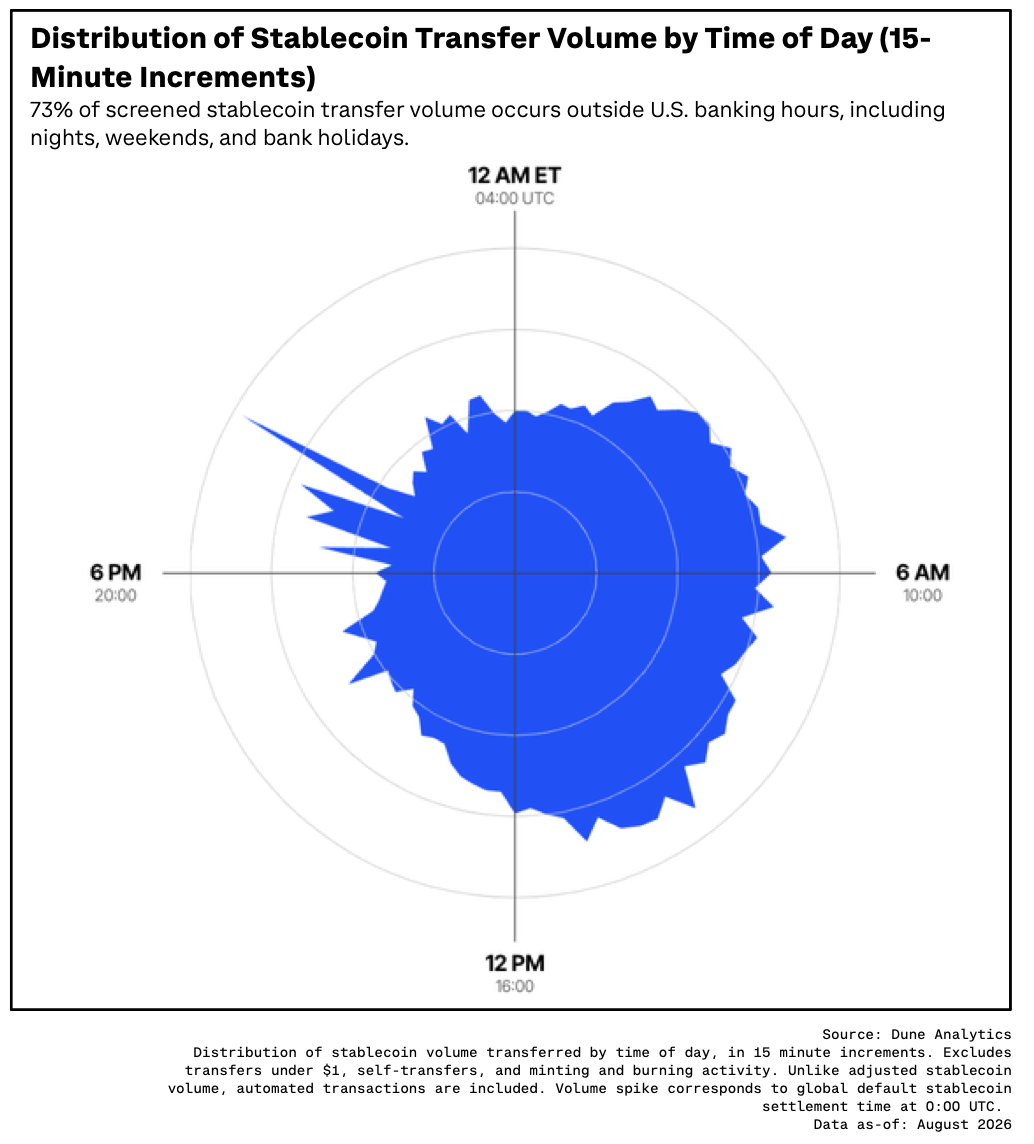
Regulators debating stablecoin oversight have spent years asking whether digital dollar substitutes pose systemic risk. A new dataset from Coinbase and The Block Research reframes that question entirely: the more pressing issue may be that stablecoins are functioning as a full-time payment rail at a scale U.S. banking infrastructure was never designed to monitor continuously. Over the 12 months ending July 31, 2026, 73% of screened stablecoin transfer volume occurred outside U.S. banking hours – nights, weekends, and federal holidays included.
That figure is not a rounding error. It is the dominant share.
The finding lands at an awkward moment for policymakers still anchoring stablecoin oversight frameworks to bank-centric models – models built on clearing windows, business-day settlement cycles, and compliance systems that largely go dark when U.S. markets close. If nearly three-quarters of transfer activity is happening in the gaps those systems are designed to ignore, the architecture of oversight itself becomes the problem.

What the Data Actually Measures – and What It Doesn’t
The 73% figure comes with a defined methodology, and that definition matters for how regulators should read it. The Coinbase and The Block Research analysis screened transfer timing rather than aggregate dollar value moved. It excluded transfers under $1, self-transfers, and minting and burning activity. Critically, it did not exclude automated transactions, meaning some portion of that off-hours volume is bot-generated or algorithmically driven rather than manually initiated by individuals or businesses. The researchers are explicit about this: the 73% is a measure of screened transfer volume, not human-only activity.
That distinction doesn’t shrink the regulatory challenge – it complicates it. Automated transactions executing outside banking hours still move real value across real blockchain addresses. They still touch wallets subject to sanctions screening, anti-money laundering obligations, and travel rule requirements. Whether a transfer is initiated by a person or a protocol makes little difference to compliance exposure when the underlying asset clears without a correspondent bank in the loop.
The hourly throughput number adds a different dimension. In Q3 2026, organic stablecoin transfer activity averaged over $400 million per hour around the clock. This figure uses a tighter definition than the 12-month screen – described specifically as organic activity, which suggests some filtering of automated flows – but it applies to a single quarter rather than a full year. The two metrics are not directly comparable, and the report does not provide an hour-by-hour breakdown of the Q3 data split between banking and non-banking hours. What both numbers share is the implication of continuous, high-volume movement that never pauses for a settlement window.
Scale, Participation, and the Compliance Gap
Beyond timing, Coinbase reported that adjusted stablecoin transaction volume reached $891 billion in Q3 2026 alone. This is the bot-adjusted quarterly total, meaning it attempts to strip out automated inflation of the headline number. At $891 billion in a single quarter – even after that adjustment – stablecoins are processing volumes that rival mid-sized payment networks. The figure is a quarterly transaction total and should not be mathematically merged with the 73% off-hours share to produce a dollar estimate of non-banking-hours activity, because the two series handle automated transactions differently. But taken together, they describe a system moving extraordinary value at extraordinary frequency.
Participation breadth adds another layer. As of October 2026, Coinbase counted 293 million unique stablecoin addresses – defined as blockchain addresses holding a minimum balance greater than 1e-9 of a stablecoin. Address counts are not the same as individual user counts; a single person can control dozens of addresses, and some addresses belong to smart contracts or institutional custodians. Still, 293 million addresses with at least a nominal stablecoin balance is the available indicator of how widely distributed this activity is, and it suggests the ecosystem has moved well past the early-adopter phase that regulators sometimes use to justify delayed action.
The compliance implications are direct. Travel rule requirements – which mandate that financial institutions transmit identifying information about senders and receivers above threshold amounts – were written for transactions that occur within business hours and pass through intermediaries equipped to process them. Stablecoin transfers largely bypass those intermediaries entirely. When 73% of screened volume happens at times when compliance teams are offline and correspondent relationships are dormant, the practical enforcement gap between what rules require and what actually gets monitored widens considerably. Regulators in the EU have pushed stablecoin issuers toward real-time monitoring obligations under MiCA; U.S. frameworks have not yet imposed equivalent requirements at the transfer level.

The Architecture Problem Regulators Haven’t Solved
Stablecoin legislation in the U.S. has moved in fits and starts, with debate focused heavily on reserve requirements, issuer licensing, and which agency holds primary jurisdiction. Those are legitimate questions. But the Coinbase and The Block Research data points to a structural mismatch that reserve ratios don’t address: the transaction layer is running 24 hours a day while the oversight layer is not. A stablecoin issuer can hold fully audited Treasury-backed reserves and still be transmitting billions of dollars per hour through a compliance window nobody is watching.
The 12-month observation period ending July 31, 2026, was not a period of unusual market stress or speculative mania. It was an ordinary operational year for stablecoin networks, and the 73% off-hours share reflects baseline behavior – not an anomaly. That baseline is what any regulatory framework has to accommodate, not the exceptional case.
With 293 million addresses active and Q3 volume at $891 billion adjusted, the question facing regulators is no longer whether stablecoins need oversight frameworks built for always-on infrastructure. It’s how much more data needs to accumulate before those frameworks are written.
Comments are closed, but trackbacks and pingbacks are open.